Jackery 2000 v2 vs. 2000 Plus: Which Power Station Is the Better Emergency Prep?
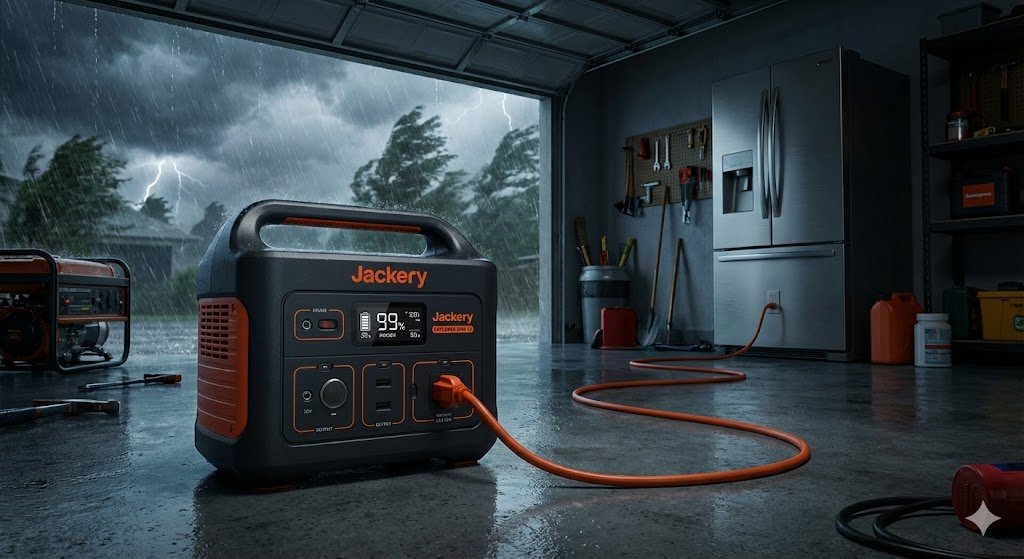
When the grid goes down, you're not shopping — you're operating with whatever you staged before the storm. That makes the pre-purchase decision more consequential than most gear choices: portability, charge speed, and output wattage all matter differently under emergency conditions than they do at a campsite.
The Jackery Explorer 2000 v2 and the Jackery 2000 Plus are both serious units. They share the same LiFePO4 battery chemistry and 4,000-cycle longevity rating. But they're built for different operational priorities — and picking the wrong one for your situation is a real cost.
Side-by-Side Spec Sheet
| Specification | Explorer 2000 v2 | 2000 Plus |
|---|---|---|
| Capacity | 2,042 Wh | 2,042 Wh |
| AC Output | 2,200W continuous / 4,400W surge | 3,000W continuous / 6,000W surge |
| Weight | ~39.5 lbs | ~62 lbs |
| Charge Speed | ~1.7 hours (Super Charge) | ~2 hours standard |
| UPS Function | Yes — ≤20ms switchover | No |
| Expandable | No | Yes — add battery packs |
| Battery Type | LFP (LiFePO4) | LFP (LiFePO4) |
| Charge Cycles | 4,000+ to 80% | 4,000+ to 80% |
| Best Use | Mobile emergency response | Fixed basecamp/home backup |
Same capacity, same battery chemistry — the divergence is in output, weight, charge speed, and UPS capability.
The 2000 v2: Built for Emergency Response Speed
The 2000 v2's defining feature isn't its capacity — it's how fast it can reach full charge and how fast it can switch to battery power when the grid drops.
The Super Charge advantage: In a rolling blackout or a pre-storm charge window, you may have 90 minutes of grid power before it goes out again. The 2000 v2's Super Charge hits 100% in approximately 1 hour 40 minutes — meaningfully faster than a standard charge cycle. That speed is a genuine operational advantage when your charge window is unpredictable.
The UPS function: The 2000 v2 switches from grid power to battery in under 20 milliseconds — fast enough that connected electronics don't register the interruption. For CPAP machines, medical equipment, or critical communication gear, this matters. Most portable power stations don't offer true UPS functionality at this price point.
The weight advantage: At 39.5 lbs — roughly 22 lbs lighter than the 2000 Plus — the 2000 v2 is one-person portable without wheels. If you need to move power from your main house to a storm shelter, a detached well pump, or a neighbor's location under emergency conditions, those 22 lbs are significant.
The honest limitation: 2,200W continuous output won't run a central AC unit or a large well pump. And without expandability, what you buy is what you have — no adding capacity later.
The 2000 Plus: Fixed Basecamp Power
The 2000 Plus trades portability and charge speed for higher output and expandability. At 3,000W continuous and 6,000W surge, it can handle loads the 2000 v2 can't — larger refrigerators, window AC units, and power-hungry tools.
The expandable battery system is its strongest long-term argument: if your power needs grow, you can add capacity without replacing the unit. For a fixed home backup installation where the station doesn't move and the power requirements are well-defined, the 2000 Plus is the correct specification.
The honest limitation: 62 lbs requires wheels and two people for any serious repositioning. In an active emergency where you need to move quickly, this is a real constraint. And without UPS functionality, there's a detectable gap when it switches to battery — relevant for sensitive electronics.
The Decision Framework
Choose the 2000 v2 if:
- Fast recharge during uncertain grid availability is a priority
- You need UPS functionality for medical or communication equipment
- Your emergency plan involves moving the unit between locations
- One-person portability is a hard requirement
Choose the 2000 Plus if:
- Your power station has a fixed location (garage, utility room)
- You're running higher-draw appliances (window AC, large refrigerator)
- Future expandability matters to your long-term prep plan
- You're building a basecamp-style home backup system
The Full Jackery Review on SafeHarborPrep
For a complete breakdown of LFP battery chemistry, what charge cycles actually mean for long-term value, and how to calculate your real power load requirements before you buy, read our full review:
Jackery Explorer 2000 v2 Full Review →
SafeHarborPrep participates in affiliate advertising programs. Links to products may earn us a commission at no additional cost to you. Our evaluations are based on technical specifications and real-world performance — not commission rates.
Related
- Grid-Down Home Power Planning: The Well Pump Question That Decides Everything
- 5 Days With No Solar: What Fails First in Your Power Stack and What to Do About It
- Is the Anker 536 a Grid-Down Survival Tool or a Camping Toy?
- How Long Does the Anker F3800 Run a Well Pump, Fridge, and Freezer?
- Will the Anker C2000 Gen 2 Last 72 Hours in a Winter Outage Without Solar?
- How Many F3800 Expansion Batteries Do You Need for a 7-Day Winter Outage Without Solar?
- How Much Solar Do You Need to Keep the Anker F3800 Running Indefinitely Off-Grid?
- Anker C1000 vs C2000 Gen 2 for Home Backup: Which Is the Correct Grid-Down Choice?
- Insulin Storage During a Power Outage: What Your Backup Power System Actually Needs
- Why Most Solar Generators Can't Start Your Well Pump: Surge Watts and 240V Explained